
Race Report: 2026 Ukiah-Mendo Gravel Hopper, Men’s 30-39
For the uninitiated, the Grasshopper Adventure Series puts on five gravel races (one a month) at the beginning of the year throughout Northern California. It’s very well run and the most approachable way to get into the gravel scene. They also have “special event” races, such as the Lost Coast Hopper later in the year, if you want to ride your bike in one of the most beautiful places in California.
Date: April 25, 2026
AVRT racers: Wil Gibb
Top Result: Wil, 3rd of 34
Course: 74 miles and 7.8k feet of climbing; starts on a 6 mile, 2,600 ft gravel climb (followed by a 3-4 mile sketchy gravel descent), followed by some road rollers with a 2-3 mile paved climb. Final selection was on a brutal 3.5 mile gravel climb at almost 9% before ~12 miles of rough descent and headwind rollers to the finish. Overall 70% dirt/sand/rocks, 30% pavement.
Nutrition: Two 1L bottles with 210g of formula 369 each, three 45g formula 369 gels
Strava: https://strava.app.link/0BGAMfKAr3b
According to Strava, this is the second hardest ride I’ve ever done – only just behind Levi’s, which was three hours longer. I suppose going into my first gravel race ever, I thought it would be more chill, with the “spirit of gravel,” and all, but I was very wrong. The race started on a 6 mile gravel climb, and one rider immediately attacked. I followed, telling myself that maybe it would be smart to get a gap before the descent. The two of us get a decent gap, but I’m giving everything just to hold the wheel. I eventually give up the wheel and am caught by a significantly reduced peloton (about 10 riders) just before the downhill. I go into the descent second wheel, but am eventually passed by the remaining nine riders and get gapped – not surprising given this is the first time I’ve raced a > 3 mile gravel descent at nearly -9%.
Fortunately, I kept close enough that I was able to catch up to the group on the next small climb and did a better job tailgunning the remaining descent into the first feed zone at 32 miles. Given this race was “only” four and a half hours, I planned to carry all my nutrition with me. Racing with 1L bottles has been a gamechanger in this regard since I can easily get ~220g in each bottle (I promise it's not as gross as it sounds). Four riders had not planned ahead and had to stop at the feed zone, and our group was down to six. We worked together well on the main stretch of pavement, swapping turns and setting a good pace while conserving energy. Eventually, some guys started skipping turns and the guy who’d attacked on the initial climb (we’d caught him just before the feed zone) attacked again, and our group was down to four.
The next selection point was a 2.5 mile paved climb at 7%. I kept my effort steady, knowing we were only halfway done, and let the wheel go for the top two riders – one of whom had won all three other grasshopper gravel races he’d entered this year. The fourth rider in our group wasn’t a climber, and he let my wheel go. I settled into my effort, thinking I’d secured a podium spot without having to go into the red for the remainder of the race.
Unfortunately, the most brutal climb was yet to come – dirt, 3.5 miles, at almost 9%. For context, the KOM on this climb (set by Pete Stetina) is only 10mph. I tried to find a balance between not falling off my bike and not completely blowing up. This balance meant that I was caught by another rider in our field about halfway up. I felt terrible, but with a possible podium in mind, I put in one last attack and was able to re-establish a gap to the fourth place rider. Once I crested the final climb, all I had to do was not crash on the sand pit hairpin descents and not cramp on the final false flat downhill headwind sections. I think the finish line photo accurately captures how I was feeling at the end of the race.
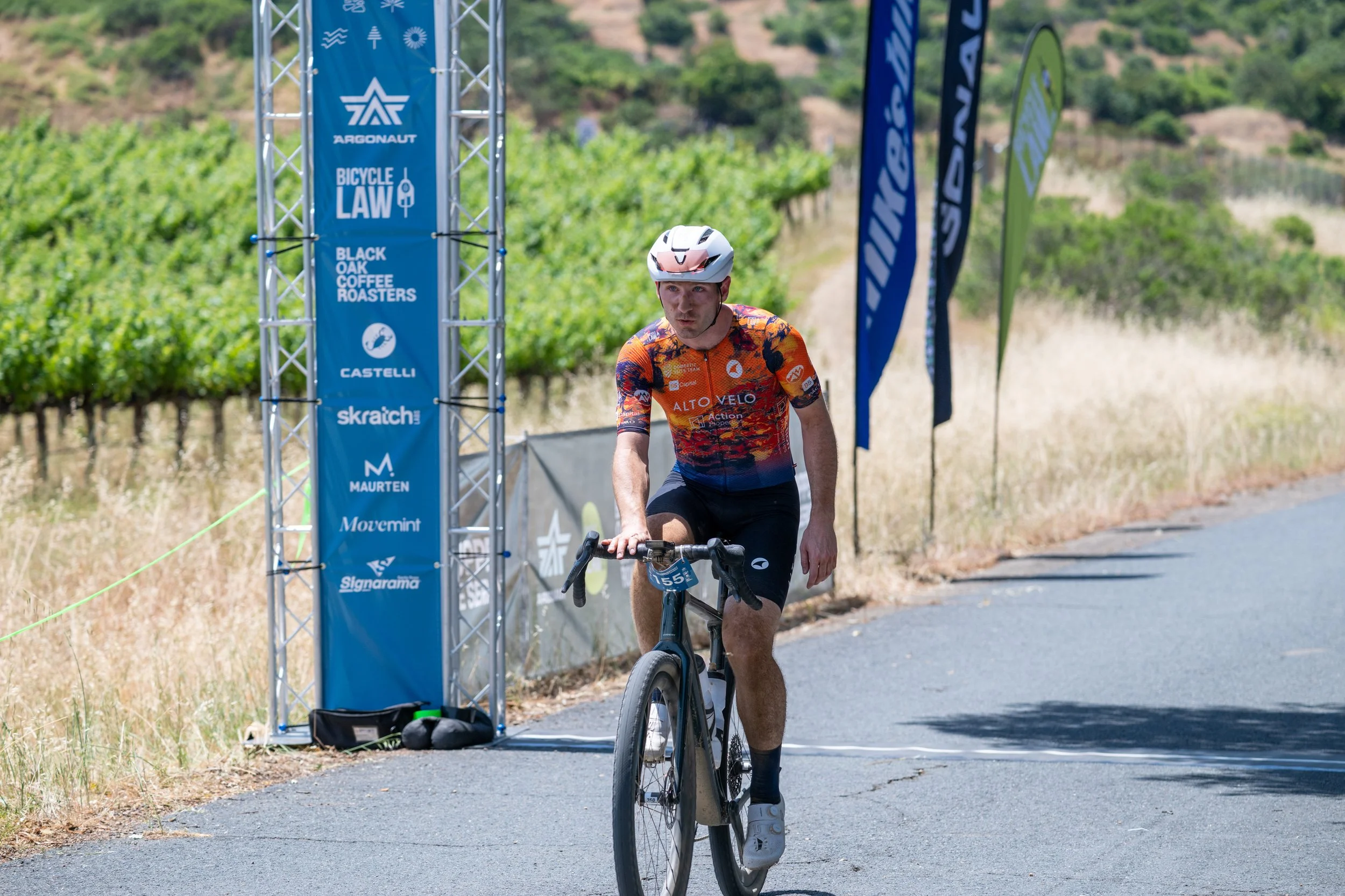
Image Credit: B Tucker Photography
Bike setup, for the ultra nerds: I ended up running 55mm Schwalbe G One RS Pro tires, which measured to 57mm, at 18psi. These are obviously wide tires, but have a relatively smooth center pattern so are good for hybrid road/gravel races. I figured if I’m racing a heavier “adventure” gravel bike (Trek Checkpoint), I might as well take advantage of its capabilities. I was extremely glad to go this wide as the course was very rough – since it was dry, there were a lot of huge ruts on the final descent that were still bone-chattering even with this setup. Maybe it was just luck, but I’m sure I had the widest tires and there were definitely other riders who flatted or crashed in the sandy/rocky sections. The only tire change I would consider making would be to go with the RX variant for better grip on corners. For my drivetrain, I have SRAM 1x13 with a 10-46 cassette and a 42 tooth chainring. On the fast downhill road sections, I definitely had to work harder to stay in the group since I was spinning out. My SRAM app tells me I was in the 46t for 10 minutes, and the 10t for 17 minutes. Probably the right setup, all things considered.